Imagine having a lush garden, a small green universe pulsating with life inside a glass jar, and the best part: you never need to water it. It sounds like magic, but it’s science, and it’s within your reach. We’re talking about self-sustaining closed terrariums, miniature ecosystems that take care of themselves, creating their own cycle of rain and humidity. It’s the perfect solution for those who love nature but don’t have the time (or luck) to keep plants alive. This isn’t just a decoration project; it’s a window into the resilience of nature, a living piece of art that evolves every day and promises to transform any environment with a touch of tranquility and wonder. Forget the guilt of forgetting to water your plants; with a terrarium, forgetting is part of the plan. Get ready to create an enchanted world that thrives on your (almost) total neglect.
The secret behind a self-sustaining terrarium is the creation of a small-scale water cycle. The water in the soil and plants evaporates with heat and light, condenses on the glass walls of the container, and then “rains” back down on the plants, continuously nourishing them. It’s a closed system, a private biome that, once established, requires minimal intervention. To start building yours, you’ll need a transparent glass container with a lid – it can be a canning jar, an old candy dish, or any glass vase that can be sealed. Transparency is crucial so that sunlight can fuel photosynthesis. In addition to the glass, you’ll need small stones or expanded clay for the drainage layer, activated charcoal to keep the water filtered and odor-free, moss to separate the layers, and, of course, the substrate and the small plants that will inhabit your new world. The choice of plants is vital: opt for species that love humidity and indirect light, such as fittonias, various mosses, mini ferns, and small ivies.
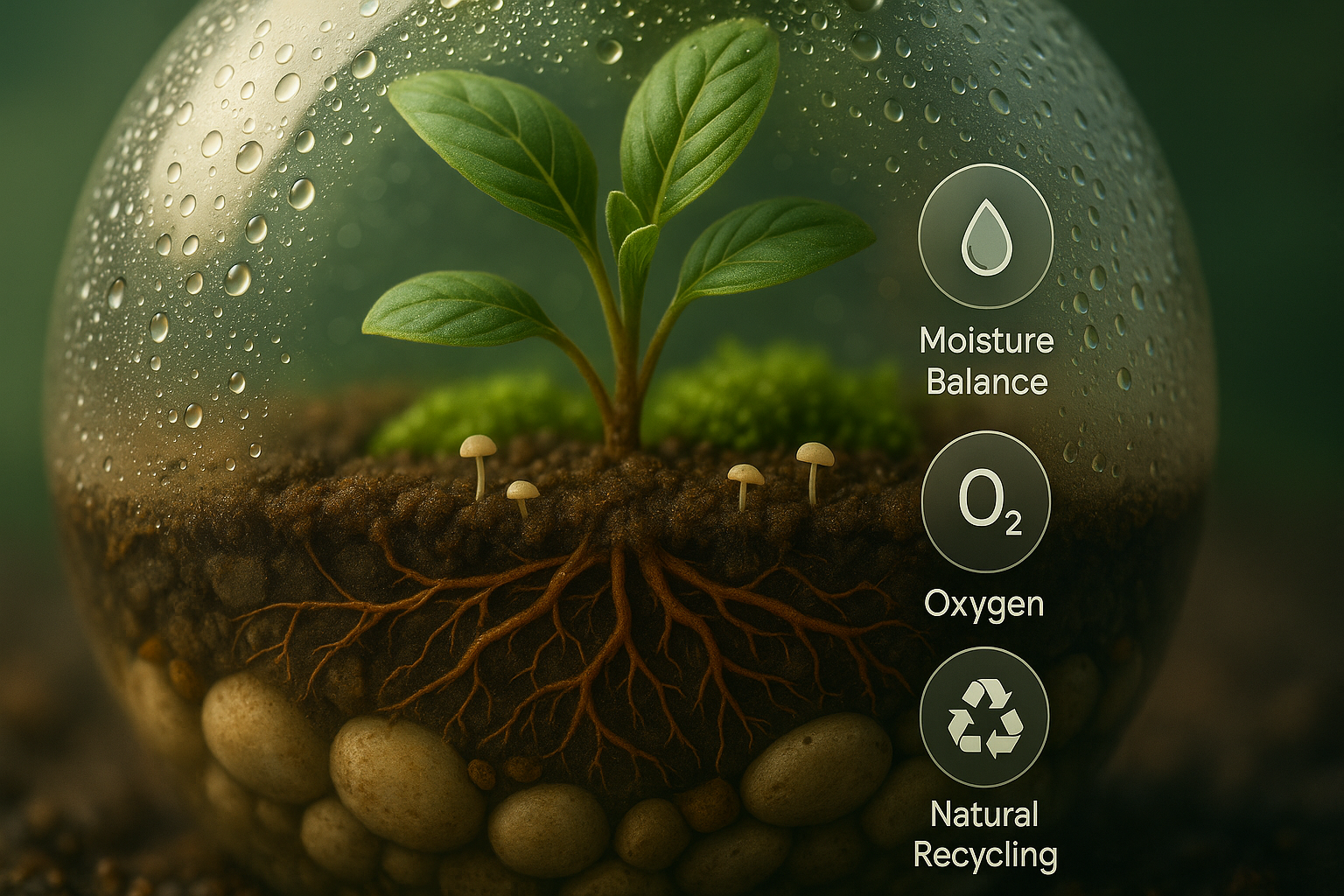
The assembly is a meditative and incredibly rewarding process. Start with a layer of about 2 to 3 centimeters of small stones at the bottom of your glass container. This drainage layer is essential to prevent the plant roots from rotting with excess water. Next, add a thin layer of activated charcoal. The charcoal acts as a natural filter, purifying the water and preventing the growth of fungi and bacteria that could unbalance your ecosystem. After the charcoal, place a layer of sphagnum moss. It will act as a barrier, preventing the soil from mixing with the drainage layer, but allowing water to pass through. Now, the main layer: the substrate. Add enough soil so that the roots of your plants have room to grow. With the base ready, it’s time to plant. Create small holes in the soil, position your plants carefully, covering their roots completely. Use your creativity to arrange the plants, stones, and mosses, creating a miniature landscape.
After planting, the final step is the initial watering – and perhaps the only one you’ll do. Spray water on the walls of the glass and over the plants until the substrate is moist, but not soggy. The amount of water is critical: ideally, you should see a little condensation on the glass walls in the morning, which disappears throughout the day. If the glass is constantly foggy, your terrarium has too much water; leave it open for a few hours to allow the excess to evaporate. If there is no condensation, it may need a little more water. Finding this balance is the key to self-sustainability. Close the lid and place your terrarium in a location with bright, indirect light. Direct sunlight can cook the plants. Now, observe. Over the next few weeks, your little world will adjust and find its rhythm. And as you admire your maintenance-free garden, why not think about how nature can be harnessed in other surprising ways? Perhaps you’ll be inspired to create a vertical garden in your kitchen and bring even more life and flavor into your home. Your terrarium is proof that, with a little knowledge, we can cultivate nature in the most unexpected places.
Use the share button below if you liked it.
It makes me smile, when I see it.